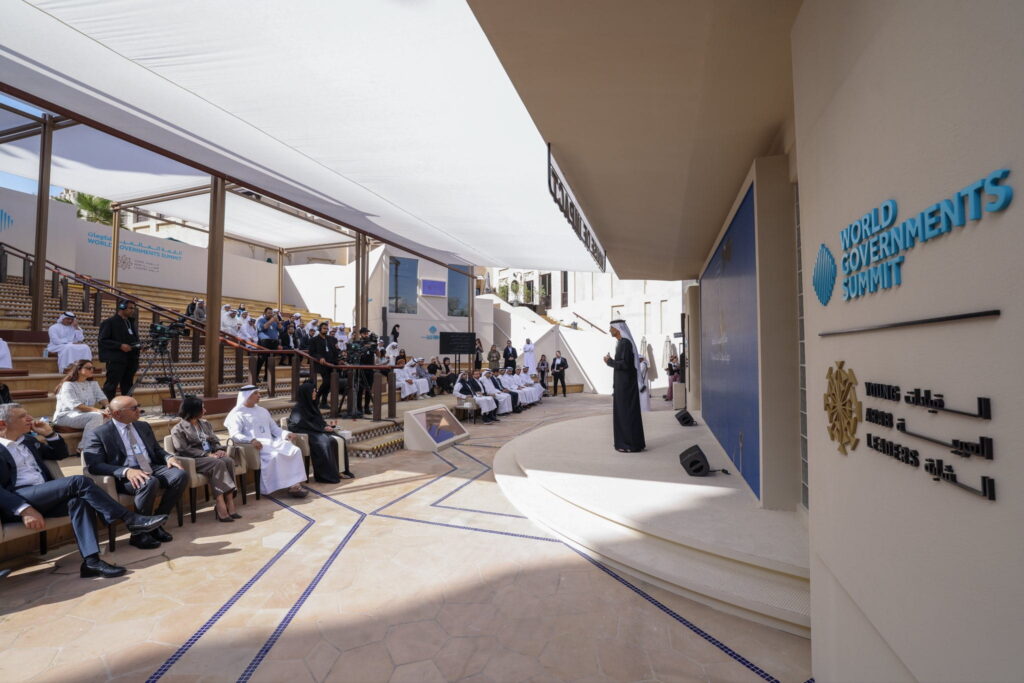
Her Highness Sheikha Latifa bint Mohammed bin Rashid Al Maktoum, Chairperson of the Dubai Culture and Arts Authority (Dubai Culture), today attended the Young Arab Leaders Forum, marking the preliminary day of the World Governments Summit 2026 in Dubai.
The forum brought together prominent Arab leaders and influential figures from across the economy, entrepreneurship, government leadership, sports innovation, culture, and the arts sectors.
The forum’s agenda featured a series of keynote and panel discussions delivered by 15 speakers, offering insights into the current reality of Arab youth and the promising opportunities ahead. Discussions also highlighted key challenges facing young people today and explored practical pathways to overcome them, with a focus on preparing Arab youth to navigate future transformations.
The Young Arab Leaders network currently includes more than 700 young Arab men and women from across the region. It aims to foster dialogue on empowering Arab youth across diverse fields, harnessing their vast potential and capabilities to advance their communities, and cultivating a new generation of capable young leaders who can drive transformative progress across future-oriented sectors.
In his opening address, His Excellency Khalfan Belhoul, Chairman of Young Arab Leaders, said launching the Young Arab Leaders network 20 years ago highlighted the unwavering belief of His Highness Sheikh Mohammed bin Rashid Al Maktoum, Vice President and Prime Minister of the UAE and Ruler of Dubai, in the importance of empowering the youth and encouraging their involvement in development and shaping the future. He emphasised that Arab youth do not merely dream of the future; they have the courage to shape it and the capacity to shoulder its responsibilities.
HE Belhoul said: “The future of the Arab world will be shaped through investment in people, and by cultivating leaders who have both vision and capability, who understand the realities of economic transformation, and engage with the fundamental questions it raises about humanity, the meaning of life, work, and belonging.”
He added: “Our world is changing rapidly, but one truth remains constant: the greatest investment is investment in people. We want Arab youth to keep up with rapid technological progress without losing their humanity, to build economies without compromising their values, and to shape the future without turning away from reality. Through the Young Arab Leaders initiative, we will continue to advance into a new phase; one that is more impactful and more rigorous in measuring real, tangible outcomes across our Arab societies.”
Technology and talent in focus
Ahmed Galal Ismail, CEO of Majid Al Futtaim Holding in Egypt, spoke during a session titled ‘The Human Algorithm: Leading at Scale in the Age of AI’ about the importance of empowering Arab youth with the tools and skills to keep pace with technological transformations.
His Excellency Abdulwahab Alrasheed, former Minister of Finance and Minister of State for Economic Affairs and Investment in Kuwait, participated alongside Rabea Ataya, Co-founder and CEO of Bayt.com, and Walid Mansour, Co-founder and Co-CEO of MEVP, Lebanon, in a session titled ‘The Multiplier Effect: Aligning Sovereign, VC, and Talent.’
His Highness Sayyid Azzan bin Qais Al Said, Founder and CEO of Etlaq Spaceport in the Sultanate of Oman, and Emirati astronaut Hazzaa Al Mansoori participated in a session titled ‘The Space Silk Road: Launching Sovereign Ambition from Arab Soil,’ moderated by His Excellency Mohamed Al Kaabi, Executive Director of the Media Office of Ajman Government.
Another session titled ‘Designing the Digital and Physical Fabric of the Arab World,’ featured Nadine Mezher, Faisal Toukan, and Talal Toukan, followed by a session with Sarah Al Battouty, Founder and Chairwoman of ECOnsult, Egypt, in a session titled ‘The Circular Frontier: Waste-to-Wealth and the New Social Contract.’
The Young Arab Leaders Forum concluded with a session featuring Fadi Ghandour, Chairman of Wamda, titled ‘The Post-Infrastructure Leader Building Grit in an AI-Native World.’ Ghandour addressed key aspects of preparing young people for the future and emphasised that Arab youth possess immense potential and ambitious aspirations that must be translated into reality despite the challenges.
Future-focused projects
Looking ahead, the Young Arab Leaders initiative aims to develop and implement a range of future-focused projects and inspiring ideas with Arab youth, leveraging the capabilities and expertise of its members to motivate and empower the next generation of Arab leaders.
The Young Arab Leaders Forum also seeks to support the launch of impactful initiatives and projects in the period ahead, drawing on the collective expertise of participating Arab leaders and expanding the role of young Arab leadership across broader sectors.
The Board of Directors of Young Arab Leaders includes HE Khalfan Belhoul (UAE), Sheikh Abdulla bin Khalifa Al Khalifa (Bahrain), Tamam Menko (Jordan), Fahad AlGhanim (Kuwait), Aissata Lam (Mauritania), Nasser Al Khater (Qatar), Ibrahim Mohtaseb (Saudi Arabia), Mona Ataya (Palestine), Basil El-Baz (Egypt), Yazan Al Tamimi (Iraq), Sami Daud (Oman), and Fatma Rashid Bujsaim (Secretary-General of the Young Arab Leaders initiative).